


Cardano: Pioneering the Future Blockchain has come a long way since the early days of Bitcoin. What started as a simple peer-to-peer digital cash system has evolved into a global infrastructure for finance, identity, governance and more. Yet many first- and second-generation blockchains still struggle with the same core trade-offs: they can be secure but slow, scalable but centralized, innovative but fragile. Cardano was created to break out of this trap.Positioned as a third-generation blockchain, Cardano blockchain aims to combine rigorous academic research with practical engineering to deliver a platform that is scalable, environmentally sustainable and suitable for real-world applications. Its Ouroboros proof-of-stake consensus, layered architecture, and focus on formal verification make it very different from many competitors that adopted a “move fast and break things” mindset.
Today, Cardano: Pioneering the Future Cardano (ADA) is known not only for its innovative technology, but also for its methodical roadmap that gradually introduced decentralization, smart contracts, DeFi, NFTs, and now on-chain governance. As the ecosystem matures, Cardano is increasingly seen as a platform for governments, enterprises and developers looking to build solutions that require both robust security and regulatory awareness.In this in-depth guide, we will explore why Cardano: Pioneering the Future Cardano is pioneering the future of blockchain technology, how its core components work, and what its roadmap means for the wider crypto ecosystem.
Cardano Pioneering the Future of Blockchain Technology
Cardano: Pioneering the Future At its core, Cardano is a public, decentralized blockchain platform that uses a proof-of-stake (PoS) consensus protocol called Ouroboros. Instead of relying on energy-intensive mining like Bitcoin, Cardano secures the network through staking, where participants lock up ADA cryptocurrency to help validate blocks and earn rewards. Cardano’s design philosophy is unusually rigorous. The protocol has been developed through peer-reviewed academic research and formal methods. The team focused on building a mathematically sound foundation before enabling high-value applications such as DeFi protocols, NFT marketplaces, and real-world financial products.
Unlike many blockchains that launched features quickly and patched them later, Cardano: Pioneering the Future blockchain followed a clearly defined roadmap divided into five eras: Byron (foundation), Shelley (decentralization), Goguen (smart contracts), Basho (scaling), and Voltaire (governance). Each era introduces new capabilities while preserving compatibility and security.This slow-and-steady strategy has sometimes led critics to call Cardano “too slow,” but it also means the ecosystem has avoided many catastrophic bugs and security incidents. As the network moves deeper into the Basho and Voltaire eras, its long-term approach is starting to pay off in terms of scaling, governance and adoption.
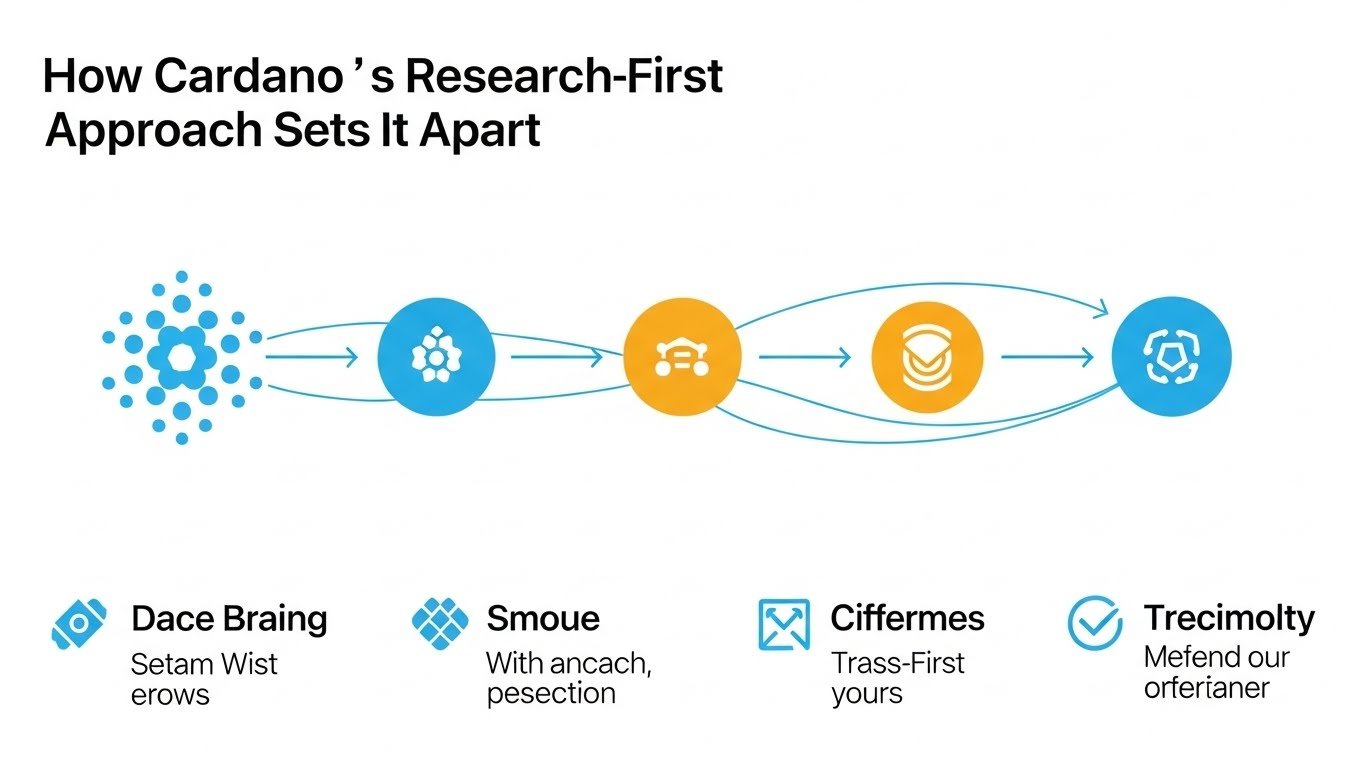
How Cardano’s Research-First Approach Sets It Apart
Academic Foundations and Formal Methods
Cardano: Pioneering the Future One of the most distinctive features of Cardano is its commitment to academic rigor. The protocol’s key components, especially Ouroboros, were developed by cryptographers and computer scientists and published in peer-reviewed venues before being implemented on mainnet. This research-first approach has several advantages. First, it gives developers and enterprises stronger assurances about the security properties of the protocol.
Second, formal specifications make it easier to verify that the implementation genuinely matches the design. Third, it helps Cardano evolve in a structured way, as future upgrades are often extensions of previously reviewed work rather than ad-hoc changes.By using formal methods and high-assurance languages like Haskell, Cardano: Pioneering the Future aims to minimize vulnerabilities in mission-critical components. This matters when building financial smart contracts, identity systems, or supply-chain solutions where failures can have serious consequences.
Ouroboros: The First Provably Secure Proof-of-Stake Protocol
The Ouroboros consensus protocol is often described as the beating heart of the Cardano blockchain. Ouroboros was one of the first PoS protocols to come with rigorous security proofs showing that, under realistic assumptions, it can achieve security guarantees comparable to Bitcoin’s proof-of-work. Instead of miners competing with computational power, Ouroboros elects slot leaders based on the amount of staked ADA.
Time is divided into epochs and slots, and in each slot, a randomly chosen stakeholder gets the right to produce a block. This design drastically reduces energy consumption and makes Cardano far more sustainable than many earlier blockchains, while preserving decentralization and security.Ouroboros has evolved through multiple versions—Classic, Praos, Genesis and more—each improving different aspects like resistance to network delays, stake distribution, and private leader selection.
Inside the Cardano Blockchain Architecture
Layered Design: Settlement and Computation
Cardano’s architecture is intentionally modular. It separates the Cardano Settlement Layer (CSL), which handles ADA transfers and consensus, from the Cardano Computation Layer (CCL), which hosts smart contracts and decentralized applications. This layered design allows upgrades and experimentation on the computation side without jeopardizing the core ledger.
This structure also makes it easier to introduce new scripting languages, virtual machines, or execution models in the future. Developers can innovate on the computation layer while the settlement layer maintains stability, security and performance. For businesses building on Cardano blockchain, this separation offers a clearer compliance and risk management model.
The Extended UTXO Model (EUTXO)
Unlike Ethereum, which uses an account-based model, Cardano uses an extended UTXO (EUTXO) model inspired by Bitcoin. In EUTXO, each transaction output can carry not only value but also complex logic and data, making it easier to reason about smart contract behavior and avoid certain classes of bugs like re-entrancy.
The EUTXO model offers strong determinism: developers can often know in advance whether a transaction will succeed before submitting it, which improves user experience and reduces wasted fees. For DeFi on Cardano, this determinism is particularly valuable, as complex interactions can be modeled with fewer unexpected side effects.
Ouroboros and Staking: Security Meets Sustainability
Energy-Efficient Security
Because Cardano uses proof-of-stake instead of proof-of-work, it consumes far less energy. Node operators do not need specialized hardware; they mainly require stable internet and reliable uptime. This makes Cardano staking more accessible to individuals and institutions compared to mining on networks that require expensive ASICs and huge power budgets.
From a sustainability perspective, this is crucial. Regulators, enterprises and environmentally conscious users often look for greener blockchain alternatives. Cardano blockchain fits naturally into this trend by offering security and decentralization with a fraction of the energy consumption associated with traditional mining.
Staking Pools and Delegation
In the Cardano ecosystem, users do not need to run their own nodes to participate in consensus. They can delegate their ADA to staking pools and earn rewards proportionally to their stake while retaining full control over their funds.
As of 2025, a large percentage of ADA supply is staked across thousands of pools, supporting decentralization and network resilience. This model encourages community participation and makes Cardano staking an attractive way for long-term holders to support the network while earning yield.
Smart Contracts, DeFi and Real-World Use Cases on Cardano
Plutus and Marlowe: Cardano’s Smart Contract Languages
With the Goguen era, Cardano introduced smart contracts through two main frameworks: Plutus and Marlowe. Plutus is a powerful, Haskell-based language for building general-purpose dApps, while Marlowe is a domain-specific language aimed at financial contracts, designed to be understandable even by non-programmers. This dual-language strategy serves both expert developers and domain specialists in finance or business. Plutus smart contracts offer expressiveness and strong typing, while Marlowe focuses on safety/
templates and visual tools. Together they underpin a growing ecosystem of Cardano DeFi platforms, DEXs, lending protocols, and other dApps.Network statistics show rapid growth in smart contract deployments, with tens of thousands of Plutus contracts and a large wave of new contracts added throughout 2024 and into 2025, signaling healthy developer activity on Cardano blockchain.
DeFi, NFTs and Emerging Ecosystem
Although Cardano entered the DeFi race later than some competitors, its ecosystem has expanded significantly. Protocols for decentralized exchange, lending, synthetic assets and stablecoins are now active on the networAt the same time, Cardano NFTs have cultivated a vibrant creator community, with marketplaces showcasing art, collectibles and gaming assets.
The low fees and predictable transaction behavior of the EUTXO model create a favorable environment for NFT platforms and GameFi.What makes Cardano DeFi and NFT projects especially interesting is their emphasis on security audits, formal methods and regulatory readiness, reflecting the broader ethos of the chain.
Real-World Partnerships and Enterprise Use Cases
Beyond the crypto-native space, Cardano blockchain has pursued partnerships in areas like digital identity, agricultural supply chains, education credentials and government services. Various initiatives, often driven by Cardano’s founding entities and partners, demonstrate the platform’s ambition to power real-world blockchain solutions rather than purely speculative trading.
Cardano’s focus on compliance, sustainability and predictable governance makes it a natural candidate for institutions exploring enterprise blockchain deployments, especially in regions where financial inclusion and digital infrastructure are still developing.
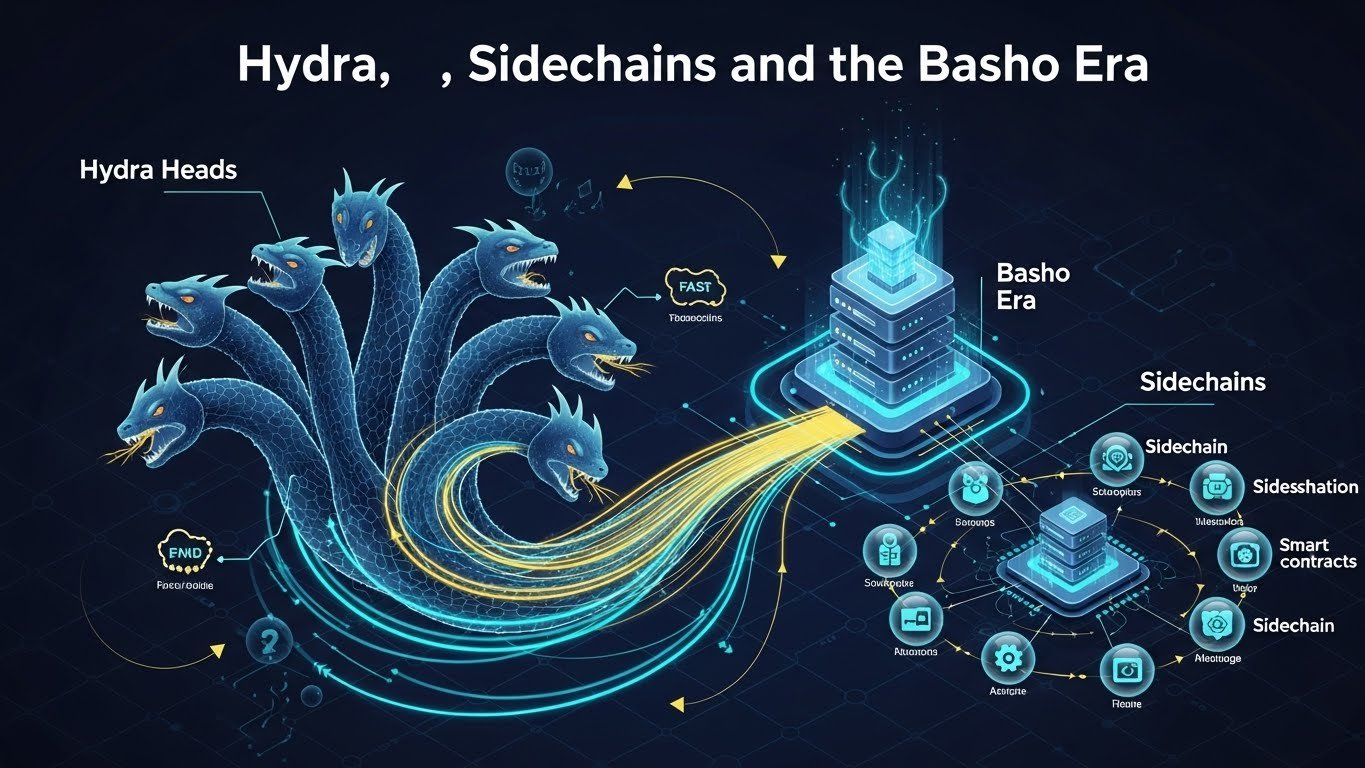
Scaling for the Future: Hydra, Sidechains and the Basho Era
Hydra: Layer-2 Scaling for Massive Throughput
To truly pioneer the future of blockchain, Cardano must scale to handle millions of users and complex applications. The Basho era is dedicated to optimization and scalability, and one of its flagship technologies is Hydra, a layer-2 solution. Hydra uses off-chain state channels called “heads,” where participants can transact rapidly and cheaply before settling back on the main chain.
Each Hydra head has the potential to process a high number of transactions per second. With many heads running in parallel, overall throughput could reach massive levels while preserving the security of the base layer.This layered approach aligns with the broader industry shift toward modular blockchains, where a secure base layer is complemented by specialized scaling layers.
Sidechains and Interoperability
Another key component of the Basho era is the introduction of sidechains: interoperable blockchains connected to the main Cardano network. Sidechains can host specialized features, alternative execution environments, or permissioned networks for enterprises. This allows Cardano blockchain to support experimentation and niche use cases without cluttering or compromising the main chain.
It also opens the door to stronger cross-chain interoperability, enabling Cardano to integrate with other ecosystems and legacy systems.By combining Hydra, sidechains, and ongoing optimizations like pipelining, Cardano aims to meet the demands of high-volume applications such as payments, DeFi, and gaming while maintaining stability and decentralization.
Governance and Sustainability: The Voltaire Era Cardano: Pioneering the Future
On-Chain Governance and Community Voting
Cardano: Pioneering the Future The final phase of Cardano’s roadmap, Voltaire, focuses on decentralizing governance and funding. In this era, the community will have the tools to propose protocol changes, vote on improvements and manage a treasury that funds future development. Central to Voltaire is CIP-1694, a governance framework that gives ADA holders a formal voice in decision-making.
Through on-chain voting, community members can shape the direction of the Cardano: Pioneering the Future blockchain in areas like parameter changes, funding proposals, and core upgradesThis transition to self-sustaining governance is crucial for long-term survival. Instead of depending indefinitely on a single company or foundation, Cardano aims to become a truly decentralized common infrastructure, guided by its global community.
Treasury and Long-Term Funding
To support continuous innovation, Cardano includes a treasury system that receives a portion of block rewards and transaction fees. Over time, this pool of funds will be used to finance proposals that the community deems valuable, such as new tools, research, dApps or infrastructure upgrades.
This design mirrors the way some open-source projects and public goods are funded, but encoded directly into the protocol. It strengthens the idea of Cardano blockchain as a public, digital infrastructure with its own built-in mechanism for evolution and maintenance.
Why Cardano Matters in the Wider Crypto Ecosystem
Third-Generation Design Philosophy
When people describe Cardano as a “third-generation blockchain,” they usually mean three things: scalability, interoperability and sustainability. The combination of Ouroboros PoS, Hydra layer-2, sidechains, and a layered architecture gives the network a credible path to high throughput without sacrificing decentralization.
At the same time, Cardano’s focus on interoperability and governance reflects a mature understanding that blockchains must coexist with each other and with traditional systems. Its emphasis on low energy usage and formal proofs positions it well in a world where regulators and institutions look closely at security and environmental impact.
Strengths and Challenges
Cardano blockchain has both strengths and challenges. Its strengths includIts challenges include intense competition from other smart contract platforms, frequent debates over its development speed, and the need to maintain developer momentum and user adoption in a fast-moving industry.
However, as on-chain metrics show continued growth in Cardano smart contracts, transaction activity and staking participation, many see it as a resilient, high-conviction platform for long-term builders and investors.
Conclusion
Cardano is truly pioneering the future of blockchain technology by combining rigorous scientific research, sustainable proof-of-stake, and a thoughtful roadmap that leads from foundation to decentralization, smart contracts, scaling and governance. Its layered architecture, Ouroboros consensus, Hydra scaling, and Voltaire governance framework position it as a serious contender for powering global-scale applications.While no blockchain is perfect, Cardano blockchain offers a compelling blend of security, sustainability and innovation. For developers,
it provides robust tooling and a deterministic execution model; for businesses and governments, it offers compliance-friendly infrastructure backed by formal methods; for users and stakers, it offers a way to participate in a decentralized ecosystem that they can help govern.As the network advances through the Basho and Voltaire eras, the real test will be adoption: how many impactful dApps, real-world partnerships, and community-driven innovations emerge on top of this carefully engineered foundation. If current trends in smart contract growth, DeFi activity and governance progress continue, Cardano is well-positioned to remain one of the most influential platforms in the evolving blockchain landscape.
FAQs
Q: What is Cardano: Pioneering the Futureand how is it different from other blockchains?
Cardano: Pioneering the Future is a third-generation blockchain platform that uses the Ouroboros proof-of-stake protocol to achieve security and decentralization with far lower energy consumption than proof-of-work networks. Unlike many competitors, Cardano is built on peer-reviewed research and formal methods, with a roadmap that gradually introduced decentralization, smart contracts, scaling technologies like Hydra, and now on-chain governance through the Voltaire era.
Q: What is ADA and what role does it play in the Cardano: Pioneering the Future ecosystem?
ADA is the native cryptocurrency of the Cardano: Pioneering the Future blockchain. It is used to pay transaction fees, deploy and interact with smart contracts, and participate in staking and governance. Holders can delegate their ADA to staking pools to help secure the network and earn rewards, and in the Voltaire era, ADA will also be used to vote on governance proposals and treasury allocations.
Q: How does Cardano achieve scalability?
Cardano’s scalability strategy is multi-layered. At the base layer, optimizations such as pipelining and parameter tuning improve throughput. On top of that, the Basho era introduces Hydra, a layer-2 scaling solution that uses off-chain heads for fast, low-cost transactions, and sidechains that allow specialized blockchains to connect to the main network. Together, these elements are designed to help Cardano support millions of users and high-volume applications without sacrificing security or decentralization.
Q: What kind of applications are being built on Cardano Pioneering the Future?
Developers are building a wide range of applications on Cardano Pioneering the Future, including DeFi platforms for trading, lending and yield farming, NFT marketplaces, identity solutions, supply-chain tracking systems, and more. Thanks to Plutus and Marlowe smart contracts, the ecosystem includes both general-purpose dApps and finance-focused contracts designed for safety and auditability. Growing numbers of deployed contracts and active projects indicate that the Cardano ecosystem is maturing and diversifying.
Q: Is Cardano Pioneering the Future a good long-term blockchain to build on or invest in?
Whether Cardano: Pioneering the Future is a good long-term choice depends on your goals and risk tolerance, but there are several reasons many builders and investors find it attractive. Its research-driven design, energy-efficient proof-of-stake, strong emphasis on security, and clear roadmap for scaling and governance all contribute to its appeal. At the same time, it faces stiff competition from other smart contract platforms and must continue to grow its developer and user base to maintain relevance. Anyone considering building on or investing in Cardano blockchain should research the technology, roadmap, ecosystem metrics and regulatory environment before making decisions.
