


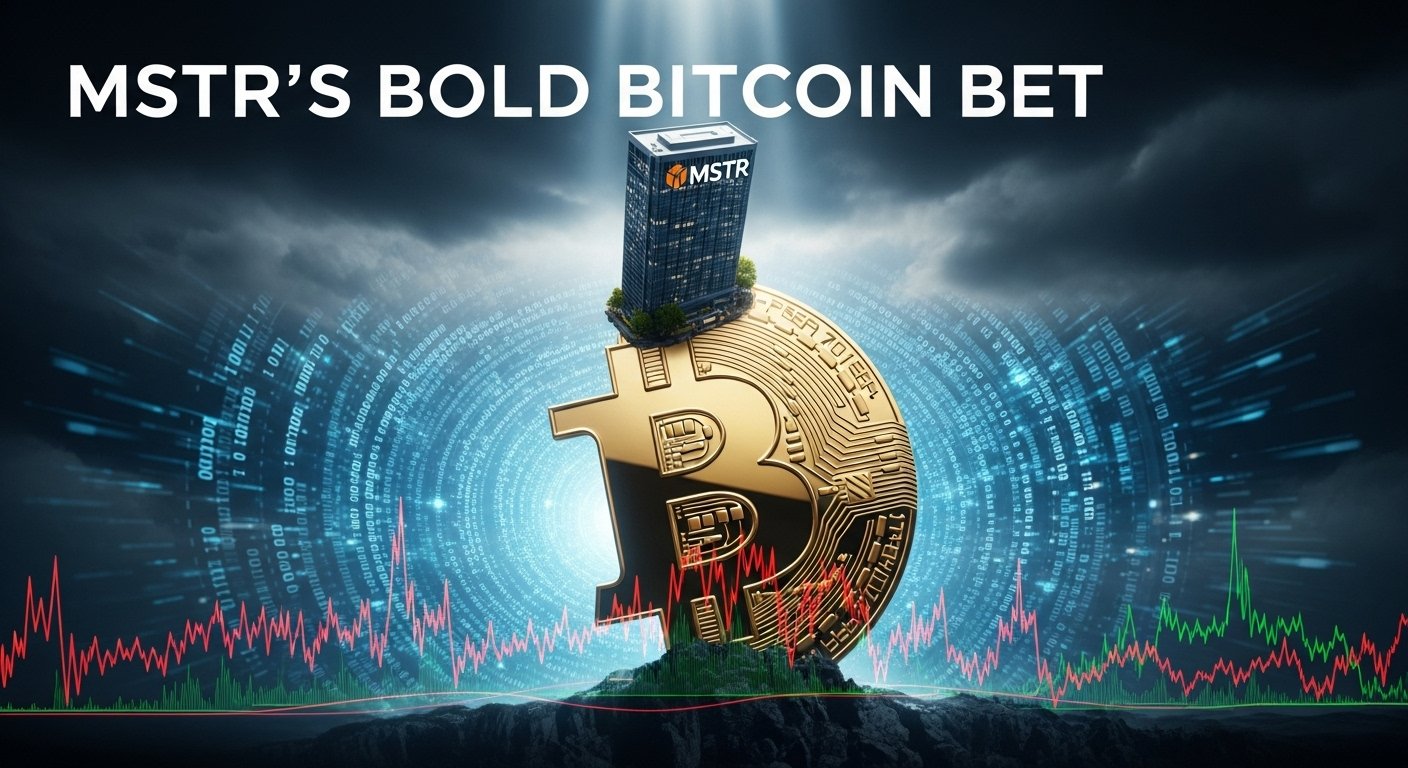
Strategy Inc (MSTR), still closely associated with its former name MicroStrategy, has undergone one of the most dramatic corporate transformations in modern markets. What began as a standard enterprise analytics company has shifted into an entirely new identity: a Bitcoin-centric strategic vehicle that aggressively accumulates digital assets. This shift began in 2020 when the company reallocated its treasury into Bitcoin, framing the move as an inflation hedge. Over time, the decision evolved far beyond a simple balance-sheet strategy and effectively turned MSTR into a Bitcoin treasury company.
Today, the company holds an enormous stash of Bitcoin purchased across multiple financing cycles, making it the largest corporate holder of BTC worldwide. This vast accumulation has driven both significant gains and substantial volatility. Investors following analysis from groups like Simply Wall St consistently face a fundamental question. Will MSTR’s bold Bitcoin bet redefine the company’s risk profile in a way that benefits investors, or will it ultimately test the patience of shareholders who may not be prepared for extreme swings linked to cryptocurrency markets?To answer that, we must how the company shifted its operating philosophy, how it funds its Bitcoin purchases, the risks embedded within its current strategy, and how investor sentiment adapts to these dynamics across both bullish and bearish cycles.
Strategy (MSTR)’s Transformation into a Bitcoin Treasury Company

From Analytics Software to Bitcoin-Focused Holding Entity
MicroStrategy once competed in a traditional enterprise analytics field, offering software services to global companies. Although those operations still exist, the organization is no longer valued through a software-centric lens. The market now views MSTR through a crypto-heavy framework. The software business generates revenue, but its contribution to investor interest has diminished substantially compared to the influence of Bitcoin fluctuations.The pivot to Bitcoin was initially presented as a treasury strategy aimed at protecting the company’s assets from inflation. As leadership grew more confident in Bitcoin’s long-term trajectory, the company shifted from passive accumulation to an aggressive acquisition model supported by creative financing arrangements. These developments ultimately pushed MSTR into a unique position where its valuation increasingly reflected its Bitcoin holdings rather than the performance of its software products.
The Rationale Behind Turning Bitcoin into the Core Corporate Asset
The heart of MSTR’s transformation lies in leadership’s conviction that Bitcoin functions as a superior long-term store of value. The company argues that a scarce, decentralized asset offers stronger inflation protection than cash or short-duration bonds. This view motivated the leadership team, particularly executive chairman Michael Saylor, to adopt a strategy that relies on available financing mechanisms to continually purchase additional Bitcoin.The strategy aims to amplify Bitcoin’s upside by using debt, preferred equity, and share issuance to expand holdings. In bull cycles, the structure allows the company to benefit not only from Bitcoin appreciation but also from increased investor demand for leveraged Bitcoin exposure. In short, MSTR’s Bitcoin-centric identity is not an accidental evolution but a deliberate attempt to merge corporate finance with the principles of digital scarcity.
Inside MSTR’s Bold Bitcoin Bet
The Scale of the Company’s Bitcoin Holdings
MSTR holds one of the largest Bitcoin treasuries in existence, with more than 640,000 BTC accumulated since 2020. These purchases were made consistently across various price cycles, and the company rarely sells its holdings. Instead, it continues acquiring Bitcoin even during periods of market weakness.The enormous scale of these holdings means Bitcoin’s price dictates the majority of MSTR’s market valuation. When Bitcoin rises, MSTR often experiences outsized gains due to its leveraged exposure. When Bitcoin falls, the stock declines even faster. The legacy software operations, though operationally important, play a secondary role in market perception.
Financing the Bitcoin Acquisition Strategy
To support continuous purchasing, MSTR relies heavily on external financing. This includes convertible bonds, preferred stock, and at-the-market equity offerings. Convertible debt allows investors to exchange bonds for equity, which becomes increasingly attractive during strong rallies. Preferred stock issuances create fixed obligations for the company but provide access to large pools of capital quickly. Equity offerings dilute existing shareholders but give MSTR fresh funds to buy more Bitcoin whenever market sentiment supports higher share prices.This financing ecosystem has created a cycle in which the company buys Bitcoin, experiences valuation growth during crypto surges, and subsequently raises new capital from an elevated share price position. That new capital is then redeployed into Bitcoin, fueling further accumulation.
Market Volatility as an Operational Feature
The structure of MSTR’s strategy essentially transforms volatility into a functional tool. High volatility enhances the value of equity-linked securities, which allows the company to raise capital on comparatively favorable terms during optimistic periods. The strategy, therefore, relies on the expectation that strong Bitcoin cycles will repeatedly allow for new rounds of financing. This makes volatility not merely a consequence of the company’s direction but an intentional component of its growth model.
How the Bitcoin Bet Redefines Strategy’s Risk Profile

A Balance Sheet Dominated by Bitcoin Price Sensitivity
Before the pivot, MSTR’s risk was tied to software adoption, competition, and technology cycles. Now the balance-sheet risk primarily reflects Bitcoin price movements. As Bitcoin climbs, the company’s asset value surges, sometimes pushing the stock to trade at a considerable premium relative to the intrinsic value of its Bitcoin holdings. When Bitcoin drops, both book value and earnings suffer due to fair-value adjustments, impairments, and investor sentiment shifts. MSTR’s stock has become significantly more volatile than the broader market. This volatility reflects both Bitcoin price movements and the leverage embedded within MSTR’s financing structure.
A Shift from Operational to Financial Risk
Although the software business continues to produce revenue, the financial story overwhelmingly depends on digital asset valuation rather than traditional operations. Earnings often fluctuate based on Bitcoin’s mark-to-market changes rather than cash flow generated from product sales. This shift has introduced a new layer of risk that resembles investment-fund volatility rather than the predictable rhythms of a recurring-revenue software enterprise.
Accounting, Liquidity, and Regulatory Complexity
The company’s large Bitcoin position creates accounting challenges that are not common for traditional public firms. Regulatory changes could also impose new restrictions on how digital assets are reported or held. Additionally, MSTR’s ongoing commitment to acquiring Bitcoin requires continuous access to capital markets. If investor enthusiasm weakens or interest rates rise, the company could face higher financing costs or more difficult fundraising conditions.
Will Investor Patience Be Tested?
The Appeal During Bitcoin Bull Markets
During strong crypto bull markets, MSTR often rises even faster than Bitcoin itself. Investors are drawn to the company as a leveraged proxy for Bitcoin exposure. Analyst outlooks tend to become more optimistic, and the company’s financing capabilities expand. In such cycles, investor patience is not strained because the strategy’s benefits are strikingly visible.
The Challenge During Market Downturns
In bear markets, the situation reverses sharply. MSTR’s valuation can decline at a pace that far exceeds Bitcoin’s own drawdowns. Prolonged weak periods can create significant stress among investors, particularly those unaccustomed to cryptocurrency volatility. Sentiment becomes fragile, and concerns around capital structure intensify. During these phases, patience is tested as shareholders must withstand large downward swings while trusting that long-term appreciation will offset short-term pain.
What Analysts Are Watching Closely
Analysts from sources such as Simply Wall St tend to focus on dilution levels, revenue stability, debt obligations, and the company’s position relative to the value of its Bitcoin holdings. Some analysts view the stock as potentially overpriced when trading at a steep premium to its Bitcoin net asset value. Others argue that the leverage embedded in the company’s structure justifies the premium for investors seeking a long-duration Bitcoin asset with amplified upside. This split perspective mirrors the broader investor debate surrounding the company.
Is MSTR a Smart Buy, Hold, or Avoid?
A Potential Fit for Bitcoin Believers
For long-term Bitcoin supporters who believe the asset will experience exponential appreciation, MSTR may offer an appealing opportunity. The company’s leveraged approach has the potential to amplify gains during future bull cycles, and its unwavering commitment to continual accumulation aligns with strong conviction in Bitcoin’s future value. Investors who adopt this view often consider MSTR a long-term strategic position.
Less Suitable for Conservative Investors
Investors who prefer steady earnings, moderate risk, and predictable financial performance may find MSTR’s strategy uncomfortable. The stock’s sensitivity to cryptocurrency markets, combined with financing complexity and potential dilution, makes it a difficult fit for portfolios emphasizing stability or income reliability.
An Active Vehicle for Short-Term Traders
For active traders, the stock offers abundant volatility and rapid price movement. MSTR’s price responds quickly to Bitcoin trends, macroeconomic announcements, and company-specific financing events. As a result, short-term traders often find it a dynamic instrument, though one that requires strict discipline.
Key Metrics Investors Should Monitor
Bitcoin Price and Trading Premium or Discount
Investors should monitor the value of MSTR’s Bitcoin holdings in comparison to its market capitalization. Understanding whether the stock trades at a premium or discount to its effective net asset value can offer insight into market sentiment and potential pricing inefficiencies.
Debt Obligations and Equity Issuance Patterns
The company’s leverage levels, interest obligations, and preferred dividends are essential metrics. Observing the pace at which MSTR issues new equity can also provide clues about dilution risk and the company’s ongoing capacity to fund Bitcoin purchases.
Performance of the Underlying Software Division
While the software business is no longer the primary driver of valuation, it remains operationally important. Stable performance or renewed growth in the analytics and AI sector may gradually introduce a firmer foundation that reduces overall corporate risk.
Conclusion
A clear conclusion emerges. MSTR’s bold Bitcoin bet has undeniably redefined the company’s risk profile. It has transitioned from a software firm into a highly specialized financial vehicle that links its fate directly to Bitcoin’s long-term trajectory. This shift has created enormous upside potential but has also introduced pronounced volatility that challenges conventional investors.Whether the company ultimately rewards shareholders or tests their patience depends largely on one’s appetite for risk and conviction in Bitcoin’s future. Investors with deep belief in Bitcoin’s long-term value may find MSTR a compelling, high-beta opportunity. Those who prioritize predictable earnings and lower volatility may feel the strategy pushes risk to uncomfortable levels.In essence, MSTR represents the purest expression of corporate Bitcoin conviction available in the public markets. Owning the stock means accepting not only Bitcoin’s volatility but also management’s willingness to amplify that volatility through aggressive financing and expansion.
FAQs
Q: Is investing in MSTR better than buying Bitcoin directly?
Investing in MSTR provides exposure to Bitcoin along with the potential for leveraged upside due to the company’s financing strategy. Buying Bitcoin directly avoids corporate risk, dilution, and financing complexity. The better choice depends on whether an investor prefers pure asset exposure or a leveraged, corporate-driven approach.
Q: How does MSTR continue purchasing Bitcoin so frequently?
The company relies on convertible debt offerings, preferred stock issuances, and equity sales. These financing tools allow MSTR to raise large amounts of capital, which it continuously deploys into Bitcoin accumulation whenever market conditions support it.
Q: What makes some analysts cautious about MSTR?
Analysts sometimes express concern about valuation premiums, high leverage, and the company’s reliance on continued access to capital markets. They also point to shareholder dilution as a recurring theme that could limit per-share value growth over time.
Q: Does the software business still matter for MSTR’s valuation?
Although the software business continues to generate revenue, it plays a secondary role in valuation. The overwhelming influence comes from Bitcoin’s price and the company’s expanding digital-asset strategy. Still, a stronger software segment could provide a stabilizing influence in the future.
Q: Who is best suited to invest in MSTR?
MSTR is best suited for investors who fully Bitcoin’s volatility and the company’s leveraged strategy. It is not ideal for conservative investors seeking dependable earnings or lower volatility. The stock appeals most to individuals who view Bitcoin as a long-term appreciating asset and who can tolerate considerable fluctuation in share price.
See More: Next Crypto to Explode Bitcoin Hyper Presale Roars Toward $27.5M
