


Solana’s Price Plunge has long been celebrated as one of the most exciting projects in the crypto space. With the Solana blockchain offering lightning-fast confirmations and low transaction fees, it quickly earned a reputation as a serious challenger to Ethereum and other major Layer-1 networks. Traders, developers, and retail investors flocked to its ecosystem, drawn by booming DeFi protocols, thriving NFT marketplaces, and the promise of a next-generation, Web3-ready infrastructure.Yet, for all the hype around speed and scalability, Solana’s latest price plunge has reminded the market that raw performance does not come without trade-offs. When the price of SOL falls sharply in a short period, it raises a crucial question: are there deeper structural dangers hiding beneath the polished surface of fast-paced blockchain platforms?
The answer is complex. Part of Solana’s decline is tied to typical crypto market volatility, sentiment shifts, and macroeconomic pressure. But another part stems from the very design decisions that made Solana famous: high throughput, cutting-edge consensus, demanding validator requirements, and a history of network instability during moments of intense stress.In this article, we will explore the underlying risks that Solana’s latest price move has brought into focus. We will look at short-term triggers, structural weaknesses, user experience challenges, and what all of this means for the future of high-speed chains. The goal is to provide a detailed, easy-to overview of why a fast chain can still be a fragile one, and how investors and users can think about those risks.
The Solana’s Latest Price Plunge
SSolana’s Price Plunge is no stranger to big price swings. In bullish markets, SOL has surged by triple digits over relatively short periods. In bearish phases, it has also experienced steep corrections. Solana’s latest price plunge fits within this broader pattern of dramatic moves, but it stands out because it comes at a time when the project appears more mature and better developed than in its early days.Several factors typically combine when Solana’s Price Plunge experiences a sudden decline. Short-term traders often pile into SOL during rallies, and as leverage builds up on exchanges, the asset becomes more vulnerable to sharp downside moves. When sentiment shifts even slightly, a wave of liquidations can hit the market, turning a modest correction into a cascade.
At the same time, Solana carries a reputational burden from its past. Even if the latest move is not directly linked to a Solana outage, many traders still remember previous incidents when the Solana network slowed down or temporarily halted. That history makes the market more sensitive and more willing to sell aggressively whenever uncertainty rises. In other words, fundamentals and technology may be stronger Solana’s Price Plunge today, but the emotional scars of earlier instability still influence how people react.In fast-moving crypto markets, this combination of leverage, memory, and fear creates the perfect environment for a sharp correction. When fast-paced blockchain platforms like Solana of the Solana’s Price Plunge move, they often move quickly and dramatically, both on the way up and on the way down.
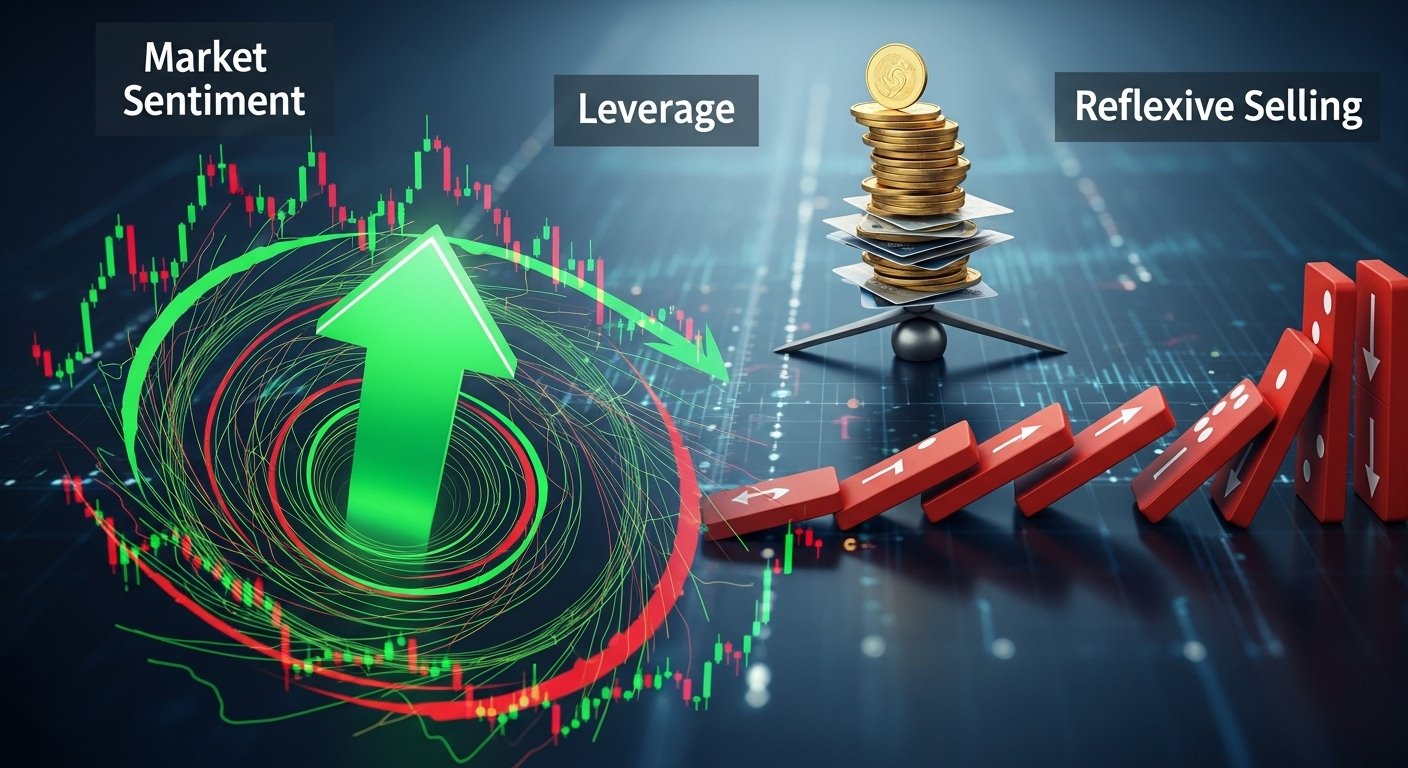
Market Sentiment, Leverage, and Reflexive Selling
How Sentiment Turns Speed into a Double-Edged Sword
One of the key features that made Solana popular is its ability to handle high-speed transactions with very low fees. This is ideal for day traders, arbitrage bots, and algorithmic strategies that rely on rapid execution. However, this same strength can turn into a hazard during periods of market volatility.When Solana is in favor, traders pile in. They open leveraged positions, stake SOL, and provide liquidity on Solana’s Price Plunge DeFi platforms. Positive narratives about the Solana’s Price Plunge ecosystem, upcoming upgrades, or institutional interest fuel optimism. Prices climb quickly, supported by both spot buying and derivatives exposure.
The trouble begins when the narrative shifts. This shift might be triggered by regulatory concerns, macroeconomic news, or simply profit-taking after a strong rally. As soon as the price begins to fall, leveraged long positions start to feel the pressure. Liquidation levels get closer, and traders rush to adjust or exit.Because Solana’s Price Plunge trading infrastructure is built for speed, liquidations can occur in rapid succession. Forced selling by exchanges feeds more downward pressure into the market. Traders see the decline on charts and panic. Selling leads to more selling, and a feedback loop of fear emerges. This self-reinforcing loop is called reflexive selling, and it is amplified by the very efficiency that normally makes the Solana’s Price Plunge blockchain so attractive.
The Role of Derivatives and DeFi in Price Crashes
The growth of Solana DeFi has introduced an additional layer of complexity. On-chain lending platforms, perpetual futures, and synthetic assets all use SOL as collateral or as a trading pair. When the price drops suddenly, collateral values shrink and liquidation engines on DeFi protocols kick in.These automated systems are designed to protect lenders and maintain solvency. They sell collateral when its value becomes too low relative to borrowed assets.
During Solana’s latest price plunge, automated liquidations can intensify downward moves, as smart contracts execute their logic relentlessly.On top of that, sophisticated DeFi strategies and yield farms often rely on leveraged positions or looping mechanisms. These strategies work well in calm markets but can unwind violently when sentiment turns. Because fast-paced blockchain platforms allow these transactions to be executed rapidly, the entire unwind process can happen in hours rather than days.
Structural Risks in Fast-Paced Blockchain Platforms

The Scalability–Security–Decentralization Trade-Off
The famous blockchain trilemma describes a tension between scalability, security, and decentralization. Solana’s design choices favor scalability and performance, aiming to deliver a high-throughput Layer-1 network that can support thousands of transactions per second. This design has enabled a rich ecosystem of NFTs, gaming, and high-frequency DeFi applications.However, pushing the limits of performance introduces unique risks. The Solana blockchain relies on powerful hardware and complex validator infrastructure. Running a top-performing validator node on Solana generally requires more computational resources than on many other chains. This can make it harder for smaller, independent operators to participate at the same level as large, well-funded entities.
Over time, this creates concerns about validator centralization. If a relatively small number of validators control a large share of the network’s stake and block production, then the system’s resilience may suffer. A failure, misconfiguration, or coordinated attack affecting a concentrated group of validators could have outsized impact on the entire network.For investors watching Solana’s latest price plunge, these structural issues matter because they shape long-term confidence. Even if there is no outage or attack today, the perception that a network may be more centralized or more fragile can influence how quickly capital flees at the first sign of trouble.
Network Congestion, Failed Transactions, and User Frustration
Another crucial risk for fast-paced blockchain platforms is network congestion and transaction reliability. Solana’s high throughput does not mean that every transaction always succeeds. In times of extreme stress, transaction failure rates can rise, especially when bots spam the network to capture MEV (Maximal Extractable Value) or exploit arbitrage opportunities.For regular users, this can be deeply frustrating. Imagine trying to exit a position during a Solana price crash, only to have your transaction fail repeatedly.
Even if fees are low, the inability to execute trades when you need them most can erode trust in the network.During Solana’s latest price plunge, many market participants worry not only about the value of their holdings but also about their ability to react. A fast chain that struggles under pressure can feel riskier than a slower but more predictable one. The fear of not being able to move funds in time becomes part of the psychological landscape, which in turn influences price behavior.
Historical Outages and Their Lingering Impact
One of the reasons Solana’s latest price plunge has attracted so much attention is the chain’s past record of network outages and instability. In previous years, Solana experienced episodes where the network had to be paused or restarted due to bugs, spam attacks, or consensus issues. During these incidents, users were temporarily unable to confirm transactions, access funds on-chain, or interact with DeFi protocols.Even though the Solana team and the broader community have worked hard to improve stability and reliability, these earlier disruptions continue to shape investor psychology. Each new period of market volatility revives old questions about whether the network might fail again under pressure.
This lingering doubt can intensify selling pressure. When traders see SOL dropping rapidly, some may remember past outages and decide not to wait around to find out whether the network will hold up this time. They sell first and ask questions later. In this way, history becomes a shadow that falls over current price action, even if the underlying technology has improved considerably.It is important to recognize that reputation in crypto is fragile. The narrative that a chain is “fast but fragile” can be difficult to shake. For Solana’s blockchain, overcoming this narrative requires consistent performance, transparent communication, and a visible track record of reliability during both quiet and turbulent periods.
Security, Phishing, and Ecosystem-Level Risks
As the Solana ecosystem has grown, so has its attractiveness to malicious actors. The combination of low fees, high-speed transactions, and an increasingly mainstream user base has created fertile ground for scams, phishing campaigns, and sophisticated exploit strategies.One significant risk comes from phishing attacks targeted at Solana users. Fake websites, malicious wallet prompts, and deceptive airdrops can trick users into signing harmful transactions or revealing sensitive information. When markets are calm, users may be more cautious, but during Solana’s latest price plunge, fear and urgency can push people into rushed decisions.
Another area of risk lies in newer and experimental DeFi protocols. Innovative platforms sometimes launch quickly to capture attention and liquidity, but they may not always undergo rigorous audits or security reviews. Exploits or smart contract vulnerabilities can lead to sudden losses of funds, adding another layer of fear during already volatile periods.These ecosystem-level risks do not always show up directly in the price of SOL on a particular day, but they contribute to the broader perception of risk. When an asset is already falling, any news of exploits, hacks, or scams on the Solana blockchain can accelerate the decline and deepen mistrust.
Strong Fundamentals vs. Violent Volatility
It might seem contradictory, but Solana’s latest price plunge can coexist with strong underlying fundamentals. The chain hosts a vibrant community of developers, builders, and projects. Activity on DeFi platforms, NFT marketplaces, gaming applications, and Web3 tools shows that the Solana ecosystem remains one of the most active and creative in the industry.Upgrades and improvements continue to roll out, including new validator clients and optimizations designed to enhance performance and stability. Infrastructure providers, analytics platforms, and tooling companies are increasingly integrating Solana, signaling long-term confidence in the Layer-1 network.
However, strong fundamentals do not cancel out volatility. In crypto, especially on fast-paced blockchain platforms, price action often overshoots in both directions. Enthusiasm pushes prices higher than fundamentals alone might justify, and fear drags them lower during corrections. The same traits that make Solana appealing as a high-performance chain also make it a magnet for speculative capital, which tends to amplify every move.For investors, this means that Solana’s latest price plunge requires looking beyond simple narratives of “good project” or “bad project.” It demands a deeper appreciation of how market structure, leverage, technology, and human psychology all interact on a chain that is built for speed.
How Users and Investors Can Think About the Risks
While this article is not financial advice, it can be helpful to outline a way of thinking about Solana’s latest price plunge and similar events on other fast-paced blockchain platforms.First, it is useful to separate short-term noise from long-term trends. In the short term, headlines, social media sentiment, and leverage unwinds can dominate price action. Over the long term, network adoption, developer activity, and real economic usage play a larger role. Watching metrics such as active addresses, on-chain volume, and DeFi total value locked can provide a more grounded perspective than price alone.Second, the unique design of the Solana blockchain helps contextualize both its strengths and its weaknesses.Its high-performance architecture, reliance on powerful hardware, and complex validator dynamics shape how the network behaves under stress.
Recognizing that Solana faces different risks than slower, more conservative chains allows for more realistic expectations.Third, awareness of user experience risks is essential. During periods like Solana’s latest price plunge, the ability to execute transactions reliably and securely becomes a central concern. Users who rely heavily on Solana DeFi, NFTs, or staking may want to how wallets, protocols, and infrastructure providers handle spikes in demand, congestion, or partial failures.Finally, emotional discipline is crucial in any volatile crypto market. Assets like SOL can experience rapid gains and painful drawdowns. For many participants, the challenge is not only analytical but emotional: avoiding panic at the bottom, resisting euphoria at the top, and focusing on a consistent strategy rather than reacting to every headline.
Outlook: Can Solana Turn Speed into Sustainable Strength?
Looking ahead, the key question is whether Solana’s Price Plunge can transform its reputation from “fast but fragile” into “fast and reliable.” If the network continues to operate smoothly through future periods of market volatility, the memory of past outages may gradually fade. Consistent performance would support the idea that technical risks have been substantially reduced, leaving primarily market and macro factors to drive price.At the same time, the broader ecosystem will need to keep addressing validator centralization, network congestion, MEV dynamics, and security concerns.
The more transparent and proactive the community is in tackling these issues, the more confidence users and institutions will place in the Solana blockchain.If Solana succeeds in combining its high-speed transactions with robust reliability, fair market structure, and strong security standards, it could stand out as one of the most compelling Layer-1 networks in the long run. In that scenario, Solana’s latest price plunge might be remembered not as a verdict on the project’s future, but as one of many intense episodes in the maturation of a fast-evolving technology.
Conclusion
Solana’s latest price plunge shines a bright light on the hidden dangers of fast-paced blockchain platforms. It highlights how leverage, sentiment, structural design, and history can work together to produce sharp price moves. It also underscores that speed alone is not enough. A truly resilient blockchain must deliver performance, decentralization, security, and reliability, especially under stress.Solana’s journey is far from over. Its ecosystem remains vibrant, its technology continues to evolve,
The community is actively working to solve the very problems that critics point to the recent plunge serves as a warning that high speed comes with high responsibility, but it is not a final judgment on the chain’s ultimate success or failure. For users and investors, the key is not to be blinded by either hype or fear. how the Solana’s Price Plunge blockchain actually works, where its risks lie, and how its ecosystem is responding allows for a more balanced view. In such a rapidly changing space, informed perspective is one of the most valuable assets you can have.
FAQs About Solana’s Latest Price Plunge
Q: Why did Solana’s price drop so quickly?
Solana’s Price Plunge tends to move quickly because it attracts active traders, leveraged positions, and heavy DeFi participation. When sentiment turns negative, liquidations in derivatives and on-chain lending can trigger rapid selling. The same speed that enables quick gains can lead to sudden declines, especially when the broader crypto market is volatile.
Q: Are Solana’s network outages still a major risk?
Past Solana network outages have definitely influenced how investors see the project, and they remain part of its reputation. However, upgrades and improvements have been implemented to reduce the likelihood of similar events. While technical risk is lower than during earlier phases, it has not disappeared entirely, and the market still reacts strongly to any hint of instability.
Q: How do fast-paced blockchain platforms increase risk?
Fast-paced blockchain platforms like Solana enable extremely quick trading, low fees, and high-frequency strategies. This is attractive for innovation and liquidity but also intensifies market volatility. Leverage can build up rapidly, liquidations can cascade, and bots can flood the network during stressful periods. All of these factors make price action more extreme in both directions.
Q: Does Solana still have strong fundamentals despite the plunge?
Yes, many observers still see strong fundamentals in the Solana’s Price Plunge ecosystem. Developer activity, growth in DeFi and NFT projects, and continuing infrastructure improvements suggest that the chain has real usage and long-term potential a Solana’s Price Plunge. A price plunge does not automatically mean that adoption is collapsing; it often reflects short-term sentiment, macro factors, and trading dynamics.
Q: What should users keep in mind when using Solana during volatile periods?
During times like Solana’s latest price plunge, users should pay close attention to transaction reliability, security, and protocol risk. It is important to double-check wallet permissions, be cautious of phishing attacks, and the Solana’s Price Plunge of how DeFi platforms handle liquidations and congestion. Staying informed about network status and being realistic about volatility can help users navigate both the opportunities and the dangers of theSolana’s Price Plunge blockchain.
