



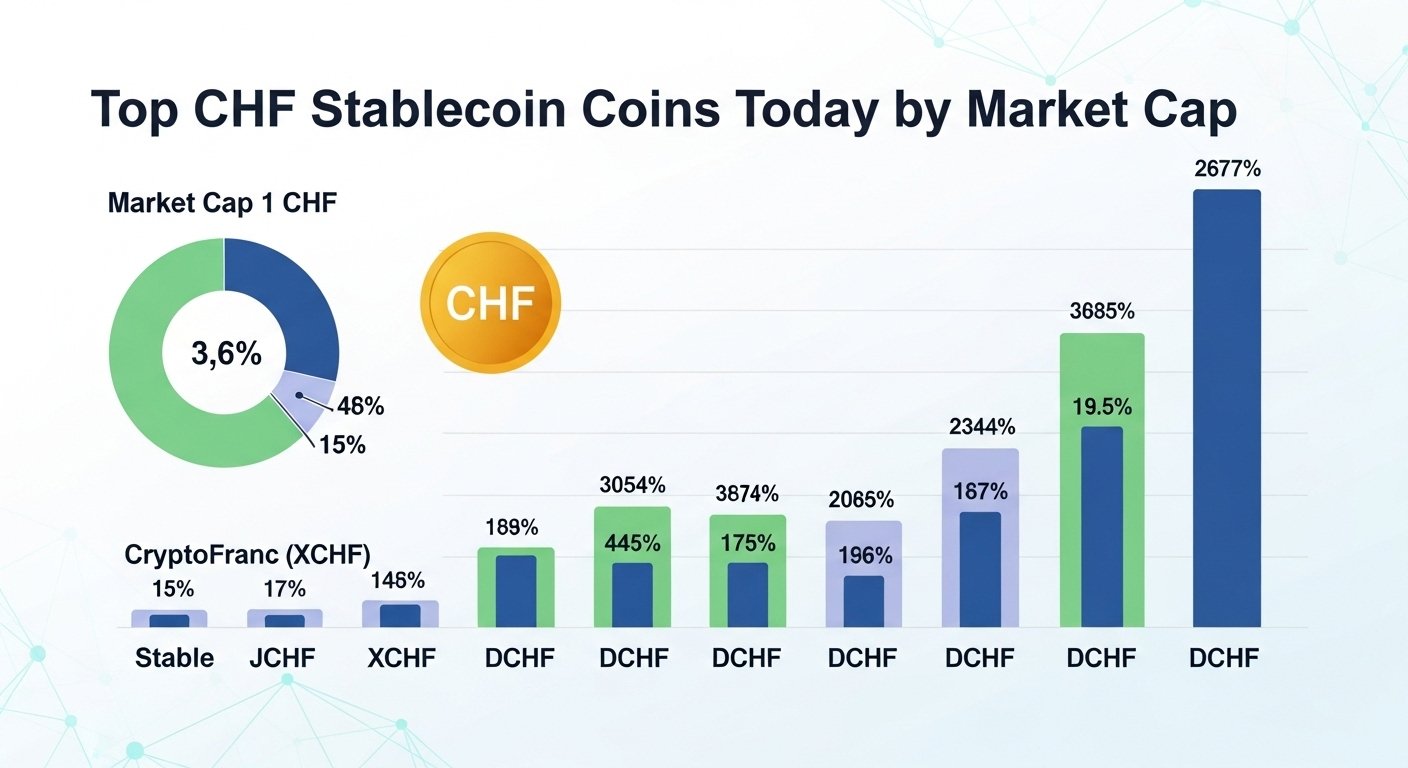
Top CHF Stablecoin Coins Today by Market Cap in 2026 the rise of stablecoins has reshaped the cryptocurrency ecosystem over the past few years. While most investors are familiar with USD-pegged tokens such as USDT and USDC, a quieter yet increasingly important segment of the market is emerging: CHF-backed digital assets. If you are searching for the top CHF stablecoin coins today by market cap, you are likely looking for alternatives that combine the reliability of the Swiss franc with the innovation of blockchain technology.
The Swiss franc has long been viewed as a safe-haven currency, associated with financial stability, strong monetary policy, and a robust banking system. When this trusted fiat currency meets decentralized networks, it creates a compelling hybrid product. CHF stablecoins aim to offer price stability, cross-border accessibility, and blockchain efficiency, all while being pegged to one of the world’s most respected national currencies.
In this in-depth guide, we will explore the top CHF stablecoin coins today by market cap, explain how they function, analyze their real-world use cases, and examine why demand for Swiss franc-pegged tokens is steadily increasing. Along the way, we will also integrate key concepts such as Swiss franc stablecoin, fiat-backed crypto, collateralized digital assets, blockchain payments, and stablecoin regulation to provide a comprehensive understanding of this niche yet powerful market segment.
Top CHF Stablecoin Coins Today by Market Cap in 2026
Before diving into the top CHF stablecoin coins today by market cap, it is essential to understand what makes them unique. A CHF stablecoin is a digital token issued on a blockchain that maintains a 1:1 peg with the Swiss franc. This means that for every token in circulation, there is typically one Swiss franc held in reserve, ensuring price stability.
Unlike volatile cryptocurrencies such as Bitcoin or Ethereum, CHF-backed tokens are designed to minimize price fluctuations. Their primary goal is stability rather than speculative gains. This makes them particularly attractive for digital payments, remittances, hedging against crypto volatility, and institutional treasury management.
The appeal of CHF-pegged tokens is closely tied to Switzerland’s reputation for financial prudence. The Swiss National Bank’s conservative monetary policy has historically preserved the franc’s purchasing power. When that stability is mirrored on-chain, it creates a digital asset that combines traditional trust with modern technology.
Another key driver behind the growth of the top CHF stablecoin coins today by market cap is increasing interest in currency diversification. Investors outside the United States and Europe are increasingly seeking exposure to alternative reserve currencies, and the Swiss franc often ranks near the top of that list.
What Determines Market Cap in CHF Stablecoins
When evaluating the top CHF stablecoin coins today by market cap, market capitalization plays a central role. Market cap is calculated by multiplying the circulating supply of a token by its price. Since CHF stablecoins are pegged 1:1 to the Swiss franc, their price remains relatively constant. Therefore, market cap growth primarily depends on adoption and token issuance.
Higher market capitalization generally indicates stronger demand, broader usage, and greater liquidity. For institutional investors, liquidity is critical because it allows large transactions without significant price impact. For retail users, higher market cap often translates into easier exchange listings and deeper trading pairs.
The top CHF stablecoin coins today by market cap typically demonstrate transparent reserve audits, regulatory compliance, and integration with reputable financial institutions. These factors contribute to user trust and sustained growth.
CryptoFranc (XCHF)
One of the leading names among the top CHF stablecoin coins today by market cap is CryptoFranc. Commonly known as XCHF, this Swiss franc-backed token has positioned itself as a trusted digital representation of CHF on blockchain networks.
Background and Issuance Model
CryptoFranc is issued by a regulated Swiss financial institution and is backed by reserves held in Swiss banks. Each token is fully collateralized, making it a true fiat-backed crypto asset. The transparency of its issuance model has helped it maintain credibility within both the crypto community and traditional finance circles.

The issuer adheres to Swiss financial regulations, which adds an extra layer of trust. In a world where regulatory clarity is becoming increasingly important, this compliance gives CryptoFranc a competitive advantage among the top CHF stablecoin coins today by market cap.
Use Cases and Adoption
CryptoFranc is commonly used for blockchain payments, settlement between crypto exchanges, and decentralized finance applications. Because it is pegged to the Swiss franc, it provides stability during periods of high volatility in other digital assets.
Many users prefer CryptoFranc as a hedging instrument when they want to exit volatile positions but remain within the crypto ecosystem. This utility has significantly contributed to its market cap growth.
Swiss Franc Stablecoin (CHFT)
Another major contender among the top CHF stablecoin coins today by market cap is Swiss Franc Stablecoin, often abbreviated as CHFT.
Structural Framework
Swiss Franc Stablecoin is designed as a fully collateralized digital asset, with reserves held in segregated accounts. Its operational structure emphasizes security, regulatory transparency, and institutional-grade custody solutions.
By leveraging established banking relationships, CHFT ensures that every token minted corresponds to a real Swiss franc held in reserve. This 1:1 backing is a cornerstone of trust within the stablecoin ecosystem.
Institutional and DeFi Integration
CHFT has increasingly found use in decentralized finance protocols, particularly for lending and borrowing platforms that seek non-USD collateral options. As global markets diversify, the demand for Swiss franc stablecoin alternatives has grown.
Its ranking among the top CHF stablecoin coins today by market cap reflects not just supply expansion but also ecosystem integration. Developers building cross-border payment systems often prefer CHF-backed tokens for their perceived stability and neutrality.
EURCHF Synthetic Stable Assets
While not always purely fiat-backed, certain synthetic tokens track the Swiss franc using algorithmic or collateral-based mechanisms. These tokens also appear in discussions about the top CHF stablecoin coins today by market cap, although their structures differ from fully reserved models.
Algorithmic vs Fiat-Backed Structures
Algorithmic CHF stablecoins rely on smart contracts and overcollateralization rather than direct bank reserves. While they can offer decentralization benefits, they often carry higher risk profiles.
Investors evaluating the top CHF stablecoin coins today by market cap should carefully assess whether a token is fully backed by fiat reserves or supported by algorithmic stabilization mechanisms. Risk tolerance and intended use cases will determine which model is more appropriate.
Why Investors Are Turning to CHF Stablecoins
The consistent growth in the top CHF stablecoin coins today by market cap is not accidental. Several macroeconomic and technological trends are fueling this expansion.
Safe-Haven Appeal
The Swiss franc’s reputation as a safe-haven currency plays a significant role. During times of global uncertainty, investors often seek assets that preserve value. CHF-backed tokens allow users to access that stability in digital form.
Diversification Beyond USD
The stablecoin market has long been dominated by dollar-pegged assets. However, overreliance on a single currency creates systemic risk. CHF stablecoins introduce diversification into the broader digital asset portfolio.
As more users recognize the importance of currency diversification, demand for the top CHF stablecoin coins today by market cap is expected to grow.
Cross-Border Efficiency
Traditional international transfers involving Swiss francs can be expensive and time-consuming. CHF stablecoins enable near-instant cross-border transactions with lower fees, leveraging blockchain technology for efficiency. This functionality is especially attractive for businesses operating across Europe and Asia.
Regulatory Landscape in Switzerland
Switzerland is widely regarded as one of the most crypto-friendly jurisdictions. Clear regulatory frameworks have encouraged innovation while maintaining strict compliance standards.
Issuers behind the top CHF stablecoin coins today by market cap typically operate under Swiss financial laws, ensuring reserve transparency and anti-money laundering compliance. This regulatory clarity boosts investor confidence and institutional participation. As global regulators intensify scrutiny on stablecoins, Switzerland’s balanced approach may continue to strengthen the position of CHF-backed tokens in the international market.
Risks Associated With CHF Stablecoins
While stability is their defining feature, CHF stablecoins are not risk-free. Counterparty risk remains a concern, particularly if reserves are not adequately audited. Investors should examine transparency reports and custodial arrangements before engaging with any token.
Additionally, liquidity constraints can arise in smaller-cap tokens. Among the top CHF stablecoin coins today by market cap, larger projects generally offer better liquidity and exchange availability. Algorithmic variants may also face de-pegging risks during market stress. Understanding these dynamics is essential for responsible participation.
The Future of CHF Stablecoins
Looking ahead, the future of the top CHF stablecoin coins today by market cap appears promising. Institutional adoption is accelerating, and decentralized finance platforms are increasingly integrating non-USD stablecoins.
As blockchain infrastructure matures, CHF-backed tokens could play a larger role in global settlements, trade finance, and tokenized securities. The convergence of traditional finance and digital assets positions Swiss franc stablecoin solutions at the intersection of stability and innovation. If current trends continue, market capitalization growth will likely reflect broader recognition of the Swiss franc’s digital potential.
Conclusion
The emergence of the top CHF stablecoin coins today by market cap marks an important evolution in the cryptocurrency landscape. By combining the credibility of the Swiss franc with the speed and transparency of blockchain networks, these tokens offer a compelling alternative to USD-dominated stablecoins.
Projects like CryptoFranc and Swiss Franc Stablecoin demonstrate how fiat-backed crypto assets can maintain price stability while enabling seamless global transactions. As demand for diversified, secure, and compliant digital assets rises, CHF stablecoins are well-positioned to capture greater market share.
For investors seeking exposure to stable digital currencies anchored to a trusted national currency, exploring the top CHF stablecoin coins today by market cap may provide both strategic diversification and technological efficiency.
FAQs
Q: What makes CHF stablecoins different from USD stablecoins?
CHF stablecoins are pegged to the Swiss franc instead of the US dollar. This offers diversification benefits and exposure to a currency historically viewed as a safe haven. While USD stablecoins dominate global trading, CHF-backed tokens provide an alternative that reflects Switzerland’s stable monetary policy and financial system. They are particularly useful for users seeking currency diversification within their digital asset portfolios.
Q: Are the top CHF stablecoin coins today by market cap fully backed by reserves?
Most leading CHF stablecoins operate on a fully collateralized model, meaning each token is backed 1:1 by Swiss franc reserves held in regulated financial institutions. However, investors should always review transparency reports and regulatory disclosures to confirm reserve backing. Some synthetic or algorithmic variants may use different stabilization mechanisms, which can carry higher risk.
Q: How can CHF stablecoins be used in real-world applications?
CHF stablecoins can be used for cross-border payments, decentralized finance lending, crypto trading pairs, and treasury management. Businesses can leverage them for efficient settlement, while individuals may use them to hedge against crypto volatility. Their blockchain-based structure enables fast and low-cost transfers compared to traditional banking systems.
Q: Are CHF stablecoins regulated in Switzerland?
Yes, many CHF stablecoin issuers operate under Swiss financial regulations. Switzerland has developed a supportive yet structured regulatory environment for digital assets. This regulatory clarity enhances trust and has helped position several tokens among the top CHF stablecoin coins today by market cap.
Q: Is investing in CHF stablecoins safe?
While CHF stablecoins aim to maintain price stability, they are not entirely risk-free. Counterparty risk, regulatory changes, and liquidity limitations can affect performance. Choosing established tokens with transparent reserve audits and strong regulatory compliance can help mitigate risks, but investors should always conduct thorough due diligence before participating.


