



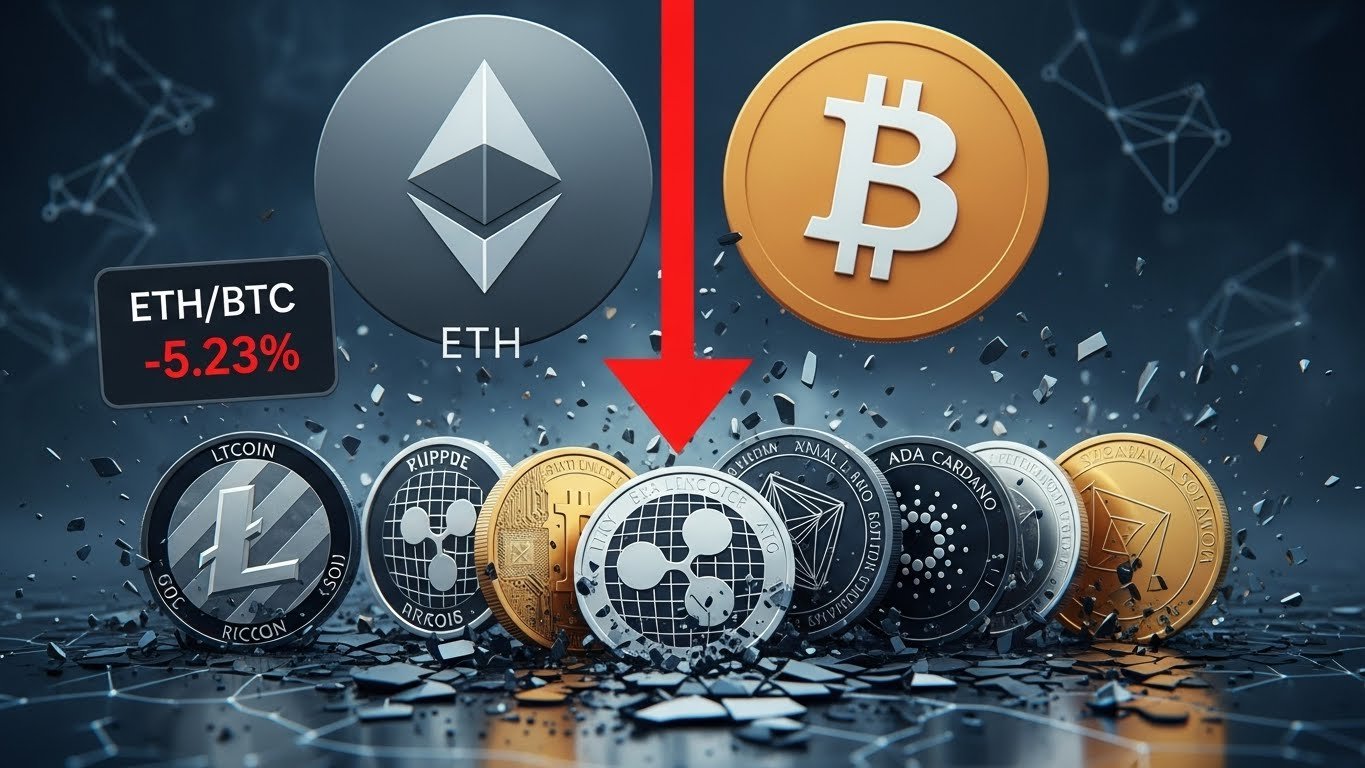
The cryptocurrency market is experiencing heightened volatility as Altcoins Under Pressure ETH/BTC Drop dynamics create widespread concern among traders and investors. A sharp decline in the Ethereum to Bitcoin ratio has sent shockwaves through the digital asset ecosystem, triggering significant selling pressure across alternative cryptocurrencies. Market participants are now closely monitoring the next 48 hours as a critical period that could determine whether this downturn represents a temporary correction or signals a more prolonged bearish phase for altcoins. The ETH/BTC ratio, long considered a barometer for altcoin health, has plummeted to levels not seen in months, raising questions about the broader market structure and whether Bitcoin’s dominance will continue expanding at the expense of alternative digital assets.
Altcoins Under Pressure ETH/BTC Drop The Ratio and Its Impact on Altcoins
Altcoins under pressure ETH/BTC serves as one of the most important indicators in cryptocurrency markets, functioning as a proxy for risk appetite among digital asset investors. When Ethereum performs well against Bitcoin, it typically signals strong confidence in alternative cryptocurrencies and often precedes periods of robust altcoin rallies. Conversely, when the ETH/BTC ratio declines, it suggests investors are rotating capital back into Bitcoin, traditionally viewed as the safer asset within the crypto ecosystem.
Altcoins under pressure ETH/BTC This relationship exists because Ethereum represents the largest and most established altcoin, hosting thousands of decentralized applications and serving as the foundation for most DeFi protocols. When traders lose confidence in Ethereum’s relative strength compared to Bitcoin, this sentiment cascades throughout the altcoin market. Smaller alternative cryptocurrencies, which typically carry higher risk profiles than Ethereum, experience even more pronounced selling pressure during these periods..
Why Altcoins Face Increasing Pressure During Altcoins Under Pressure: ETH/BTC Drop Declines
Altcoins under pressure become particularly vulnerable when the Ethereum to Bitcoin ratio deteriorates because of several interconnected market dynamics. First, many altcoins are traded primarily against Ethereum rather than fiat currencies or Bitcoin, creating direct exposure to ETH price movements. When Ethereum weakens against Bitcoin, altcoins denominated in ETH face a double negative impact: declining ETH prices and their own independent selling pressure.Additionally, institutional investors and algorithmic trading systems often use the ETH/BTC ratio as a risk management signal. When this metric falls below certain thresholds, automated systems may trigger portfolio rebalancing that involves selling altcoin positions and rotating into Bitcoin. This systematic selling can create self-reinforcing downward spirals where price declines trigger more selling, which leads to further price deterioration.
The psychological dimension cannot be understated either. Retail traders who entered altcoin positions during more optimistic market conditions may panic when they see Ethereum losing ground to Bitcoin. This fear-driven selling adds to the pressure, particularly for smaller-cap altcoins that lack the liquidity buffers of larger projects. Social media sentiment shifts rapidly during these periods, with fear and uncertainty replacing the optimistic narratives that characterized earlier market phases.Market makers and liquidity providers also adjust their strategies when volatility increases and directional trends become established. Wider bid-ask spreads and reduced depth on order books make it more difficult for traders to execute positions at favorable prices, further exacerbating the selling pressure on altcoins under pressure ETH/BTC conditions.
The Critical 48-Hour Window Traders Are Monitoring


The next 48 hours represent a pivotal period that could determine the near-term trajectory for altcoins and the broader cryptocurrency market. Several key factors make this timeframe particularly significant for traders trying to assess whether the current altcoin market downturn will continue or potentially reverse.Technical analysts have identified multiple support and resistance levels that prices are currently testing. If the ETH/BTC ratio fails to hold above critical support zones within this window, it could trigger a cascade of stop-loss orders and forced liquidations that accelerate the decline. Conversely, a strong bounce from these levels might signal that accumulation is occurring at these prices, potentially setting the stage for a recovery.
Derivatives markets show heightened uncertainty with elevated volatility indices and skewed options positioning. The funding rates on perpetual futures contracts reveal whether traders are predominantly betting on continued downside or positioning for a potential reversal. These derivative metrics often serve as leading indicators, providing early warning signals about sentiment shifts before they fully manifest in spot markets.Macro factors also play into the 48-hour significance. Scheduled economic data releases, central bank commentary, or regulatory announcements could serve as catalysts that either compound the selling pressure or provide relief. The cryptocurrency market has become increasingly correlated with traditional financial markets in recent years, meaning external factors from equity markets or fixed income can influence crypto price action.
Historical Context Previous ETH/BTC Ratio Declines and Altcoin Performance
Examining historical precedents provides valuable perspective on the current situation where altcoins under pressure ETH/BTC dynamics are creating market stress. During previous cycles, sharp drops in the Ethereum to Bitcoin ratio have produced varied outcomes depending on broader market conditions and the underlying catalysts driving the moves.In mid-2019, a similar ETH/BTC decline coincided with a period where Bitcoin surged toward fourteen thousand dollars while altcoins languished. That episode lasted several months before eventually reversing, but not before many altcoins lost substantial value against both Bitcoin and dollar terms. The recovery only materialized after Bitcoin’s rally exhausted itself and capital began rotating back into alternative cryptocurrencies.
More recently, throughout 2022 and early 2023, the ratio experienced prolonged weakness as Ethereum grappled with technological uncertainty around its transition to proof-of-stake and regulatory concerns affecting the overall crypto market. Altcoins suffered tremendously during this period, with many projects losing over ninety percent of their value from peak levels.These historical patterns reveal that the duration and severity of altcoin pressure following ETH/BTC ratio declines depends heavily on whether Bitcoin continues its relative strength, whether new catalysts emerge to support Ethereum and altcoins, and whether broader market liquidity conditions are expanding or contracting. The current situation shares characteristics with multiple historical precedents, making simple pattern-matching challenging.
Technical Analysis: Key Levels and Indicators for Altcoin Recovery
From a technical analysis perspective, several critical indicators and price levels will determine whether altcoins under pressure can stabilize and recover or face continued deterioration. The ETH/BTC chart currently shows a breakdown from a multi-month consolidation pattern, suggesting the path of least resistance may be to the downside in the near term.The relative strength index for the Ethereum to Bitcoin pair has entered oversold territory, which historically has preceded at least short-term bounces. However, during strong trending moves, RSI can remain oversold for extended periods, so this indicator alone does not guarantee an immediate reversal. Traders watch for bullish divergences where price makes lower lows but RSI forms higher lows, signaling diminishing downside momentum.
Volume analysis shows that selling volume has been elevated during the recent decline, confirming strong bearish conviction. For a sustainable recovery, traders want to see increasing volume on up days and decreasing volume on down days, indicating accumulation patterns. Current volume profiles suggest continued distribution as holders exit positions rather than buyers stepping in aggressively.Fibonacci retracement levels drawn from recent highs offer potential support zones where technical buying might emerge. The altcoin market tends to respect these mathematical ratios, with the 61.8% and 78.6% retracement levels often serving as final support before a trend completely reverses. Price action around these zones in the coming hours will be particularly telling.
Fundamental Factors Contributing to Current Altcoin Weakness
Beyond technical considerations, several fundamental factors explain why altcoins under pressure ETH/BTC conditions have emerged and intensified recently. Understanding these underlying drivers helps traders distinguish between temporary noise and more significant structural shifts in the cryptocurrency landscape.Bitcoin’s narrative as digital gold and a potential inflation hedge has gained renewed traction among institutional investors, particularly as economic uncertainty persists globally. When institutional capital flows predominantly into Bitcoin rather than diversifying across the crypto ecosystem, it naturally creates upward pressure on Bitcoin dominance and downward pressure on the ETH/BTC ratio and altcoins more broadly.
The DeFi sector, which drove much of Ethereum’s previous outperformance, has matured and stabilized. Total value locked in DeFi protocols has plateaued, and the explosive growth rates that characterized 2020 and 2021 have normalized. Without DeFi serving as a powerful growth engine, Ethereum faces challenges in justifying a higher valuation multiple against Bitcoin.Regulatory developments have created additional uncertainty specifically affecting altcoins and Ethereum. Discussions around securities classification, staking regulations, and enforcement actions have disproportionately focused on assets other than Bitcoin. This regulatory overhang creates risk premiums that investors demand when holding altcoins under pressure from potential government intervention.
Trading Strategies During Periods of Altcoin Pressure
Navigating markets when altcoins under pressure ETH/BTC dynamics dominate requires careful strategy and disciplined risk management. Different trading approaches suit various risk tolerances and market outlooks during these volatile periods.Conservative traders often respond to sharp ETH/BTC declines by reducing overall cryptocurrency exposure and rotating capital into Bitcoin or stablecoins. This defensive positioning preserves capital during uncertainty and provides optionality to re-enter altcoin positions at more attractive valuations if the selling pressure proves overdone. The opportunity cost of missing potential rebounds is weighed against the risk of catching a falling knife during an extended downtrend.
Options strategies allow sophisticated traders to express nuanced market views while defining risk parameters precisely. Buying put options on altcoins or the ETH/BTC ratio provides downside exposure with limited loss potential, while selling covered calls generates income from existing positions during sideways or declining markets. Options markets for major cryptocurrencies have matured considerably, offering various strategies for different market environments.rebalancing presents another approach where traders systematically adjust allocations based on predetermined rules rather than discretionary judgment. During periods when Bitcoin dominance rises and altcoins under pressure decline in relative value, mechanical rebalancing would involve selling Bitcoin winners and buying altcoin losers. This disciplined approach removes emotion from decision-making but requires strong adherence to systematic rules even when uncomfortable.
The Role of Bitcoin Dominance in Altcoin Market Cycles
Understanding Bitcoin dominance provides essential context for interpreting current altcoin pressure and anticipating potential market evolution. Bitcoin dominance measures Bitcoin’s market capitalization as a percentage of the total cryptocurrency market cap, serving as a useful gauge of risk appetite and capital rotation within the digital asset ecosystem.When Bitcoin dominance rises, it indicates capital flowing toward the perceived safety of the largest and most established cryptocurrency. This typically occurs during uncertain market conditions, regulatory crackdowns, or periods when new investors enter crypto markets and naturally gravitate toward Bitcoin first. The current environment shows Bitcoin dominance expanding as the ETH/BTC ratio declines, confirming this risk-off behavior.
The current Bitcoin dominance level sits near multi-year highs, suggesting altcoins have significantly underperformed relative to historical norms. This positioning creates a mathematical setup where future altcoin outperformance could be dramatic if and when sentiment shifts and capital begins rotating back into alternative cryptocurrencies. However, dominance can remain elevated for extended periods, so timing this rotation proves challenging.Some analysts argue that Bitcoin’s maturing status as an institutional asset class may structurally support higher dominance levels than historical averages. If Bitcoin increasingly serves as digital gold for institutional portfolios while altcoins remain primarily speculative retail vehicles, the dominance ratio might stabilize at permanently higher levels. This structural shift would have profound implications for altcoin market expectations and valuation frameworks.
Sector Analysis: Which Altcoin Categories Face Most Pressure
Not all altcoins under pressure experience equal selling intensity during ETH/BTC declines. Different cryptocurrency sectors show varying degrees of resilience or vulnerability based on their fundamental characteristics and market positioning.DeFi tokens have faced particularly acute pressure as the sector’s growth has stagnated and concerns about regulatory treatment intensify. Many DeFi protocols saw their tokens decline more severely than the broader altcoin market, with some projects losing over fifty percent of their value in days. The combination of declining protocol revenues, token unlock events, and regulatory uncertainty creates multiple headwinds for this category.
Infrastructure and middleware projects that provide essential services to blockchain ecosystems have demonstrated moderate stability relative to pure speculation plays. Oracle networks, cross-chain bridges, and data indexing protocols serve necessary functions that continue regardless of price volatility, providing some fundamental support for their tokens.Meme coins and highly speculative low-cap altcoins face existential risks during sustained selling pressure. Without fundamental value propositions or revenue generation, these tokens depend entirely on sustained speculative interest. When that speculation evaporates during ETH/BTC declines, many such projects see trading volumes collapse alongside prices.
Altcoins Under Pressure ETH/BTC Drop What Could Trigger an Altcoin Recovery

Altcoins Under Pressure ETH/BTC Drop While current conditions show altcoins under pressure, several potential catalysts could reverse this trend and spark renewed interest in alternative cryptocurrencies. Understanding these possible turning points helps traders remain alert to changing market dynamics.A successful defense of critical technical support levels on the ETH/BTC chart could trigger short-covering and renewed buying interest. If the ratio holds above key psychological levels and begins forming a higher low pattern, technical traders may interpret this as a sign the worst of the selling pressure has passed. Sustained defense of these levels over multiple days would strengthen the signal.
Altcoins Under Pressure ETH/BTC Drop Macroeconomic shifts that increase risk appetite across financial markets generally benefit altcoins disproportionately given their risk asset characteristics. If central banks pause monetary tightening, inflation concerns ease, or economic growth expectations improve, capital tends to flow back into speculative assets including cryptocurrencies beyond just Bitcoin.Major institutional adoption announcements can quickly change market narratives. Large technology companies integrating blockchain technology, traditional financial institutions launching crypto services, or sovereign wealth funds allocating to digital assets have historically moved markets significantly. Such announcements could break the current cycle of altcoin pressure if they specifically involve Ethereum or other alternative cryptocurrencies.
Altcoins Under Pressure ETH/BTC Drop Risk Management Principles for Altcoin Investors During Volatility
Altcoins Under Pressure ETH/BTC Drop Protecting capital while maintaining upside exposure requires thoughtful risk management when altcoins under pressure ETH/BTC conditions create treacherous market environments. Several core principles help investors navigate these periods without suffering permanent capital impairment.Position sizing becomes paramount during volatile periods. Investors should ensure no single altcoin position represents such a large portfolio percentage that its complete loss would be devastating. The old trading wisdom of never risking more than one or two percent of capital on any single trade applies particularly to speculative altcoin positions during uncertain times. Smaller positions allow for conviction without catastrophic risk.
Altcoins Under Pressure ETH/BTC Drop Maintaining adequate cash or stablecoin reserves enables opportunistic buying during panic selloffs without requiring sales of existing positions at unfavorable prices. Investors who remain fully invested during declining markets often must sell at inopportune times to raise capital for unexpected needs or better opportunities. Reserve positioning varies based on individual circumstances but generally ranges from ten to thirty percent of cryptocurrency allocations.Regular portfolio reviews and rebalancing ensure positions align with evolving market conditions and personal risk tolerance. During periods of high volatility, weekly rather than monthly reviews may be appropriate. These reviews should assess whether thesis for holding each position remains intact or whether conditions have changed sufficiently to warrant exits or position size adjustments.
Conclusion
The cryptocurrency market stands at a critical juncture as altcoins under pressure ETH/BTC dynamics create both risks and potential opportunities for astute traders and investors. The sharp decline in the Ethereum to Bitcoin ratio has triggered widespread selling across alternative cryptocurrencies, pushing many projects to important technical support levels that will likely determine near-term price direction. The next 48 hours represent a crucial window where market participants will discover whether this represents a temporary correction within an ongoing bull market or signals a more prolonged period of altcoin underperformance.Successful navigation of this environment requires balancing multiple considerations: technical analysis of key support and resistance levels, fundamental assessment of which altcoin sectors retain strong value propositions.
For traders wondering about the altcoin market trajectory, the coming hours will likely provide important clues through price action at critical levels, trading volume patterns, and derivative market positioning. Whether you choose to reduce exposure defensively, maintain conviction in quality projects, or opportunistically add to positions during fear-driven selloffs, ensure your approach aligns with your risk tolerance and investment timeline.The altcoins under pressure ETH/BTC situation demands attention and thoughtful strategy rather than emotional reaction. Stay informed about technical levels, monitor fundamental developments that could serve as catalysts, and maintain disciplined risk management regardless of short-term price action. What happens in the next 48 hours may determine the market narrative for months to come, making this a defining moment for cryptocurrency investors and the broader digital asset ecosystem.


